

It is six in the morning in Manchaa village, ninety kilometres from any railway, and Bhavna's grandmother is making tea.
She does not say much. She has not said much, by Bhavna's count, in close to thirty years. What she does, instead, is move her hands — over the warp, over the weft, into the kitchen, into the cradle, back to the loom — at a pace that the village treats as a kind of weather. You set your watch by it.
Bhavna is twenty-three. She is the third generation in this house to weave for the Foundation, and the first to attend secondary school. The school in Tonk is forty minutes by bus, in a direction the bus would not normally go. The driver took the long way for two years before she could afford to ask him to. He still won't take payment.
When the Foundation's design lead came to Manchaa last spring, she did not bring sketches. This is a thing the Foundation has learned to do — not to bring drawings to a village that has been making them for four hundred years. Instead she brought one question: “Who do you want to make a rug about?” The answer, in Bhavna's case, was the woman pouring tea.
The first drawings were almost too small to see. Bhavna had filled the back of an old school notebook with figures the size of a thumbnail: her grandmother bending, her grandmother walking, her grandmother sitting at the loom in the half-dark before sunrise. There is a particular kind of silence in those sketches that the design team kept returning to.
“It wasn't a portrait.
It was the place
she takes up in the room.”
— Bhavna, on her grandmother
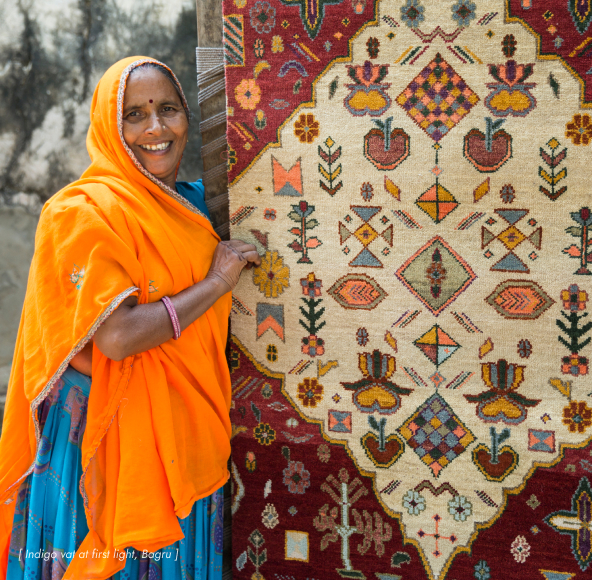
The rug took eleven months. It is six feet by nine, hand-knotted in undyed wool from the village's own flock, with a single warm madder thread running diagonally across — a small, almost private mark that the design lead added with Bhavna's permission. “A signature,” she calls it, though Bhavna prefers another word: “a footprint.”
It has since been shown in Milan, in Tokyo, in a small gallery in Brooklyn that we will not name here. It will not be sold. The Foundation's standing rule is that the first edition of any artisan-led design stays with the artisan's family. Bhavna's grandmother does not understand any of this very well. She does, however, understand that the rug is hers, and she has placed it where she always sits.
There is a temptation, in this work, to make a story bigger than it is. To wrap a single rug, a single woman, a single quiet morning in claims about resilience and craft and the larger arc of a thing called heritage. We have, in this journal, been trying to resist that temptation. To let a story be the size that it actually is.
It is six in the morning. The grandmother is making tea. The loom waits. The bus, today, will once again go the long way.
— S. K.

Sangeeta Khanna
Writes about craft, ritual, and the rural economies of north-western India. Lives in Jaipur. This is her seventh piece for the journal.


